Investors use a SaaS board pack for one reason: to decide whether the business is improving, using cash wisely, and staying on track. That’s the simple truth.
For a UK SaaS founder, that matters well beyond the board meeting itself. The same pack shapes investor confidence, fundraising conversations, and how your business looks under scrutiny. If it takes too long to read, or feels hard to trust, you’ve already made the job harder.
The strongest packs are fast to scan, easy to compare, and honest about what’s working and what isn’t. That’s what investors want to see.
The questions investors are really trying to answer
A board pack isn’t a formality. It’s a decision document. Investors aren’t reading it to admire the slides. They’re trying to work out whether the company has momentum, control, and a management team that tells the truth.
A good board pack helps an investor answer three questions fast: are you growing, are you in control, and do you know what happens next?

Is the business getting better quarter by quarter?
One strong month doesn’t carry much weight on its own. Investors want trend lines. They want to see whether ARR is moving up, whether MRR growth is holding, whether retention is stable, whether pipeline quality is improving, and whether cash use is becoming more disciplined.
Consistency matters as much as scale. A business growing at a sensible rate with controlled burn often looks stronger than one with noisy top-line growth and weak grip on cash. In 2026, that matters even more. Efficient growth beats spectacle.
Are you showing the good news and the bad news?
Trust is built when the pack says what happened, why it happened, and what changed because of it. Not spin. Not selective reporting. Straight answers.
If churn rose, say why. If a sales hire missed target, explain it. If implementation delays hurt expansion revenue, put it in the pack and show the response. Investors don’t lose confidence because a problem exists. They lose confidence when management appears slow, vague, or evasive.
Can the board make better decisions from this pack?
The best packs help the board act. They surface risks early. They make trade-offs clear. They set out the decisions that need backing, challenge, or approval.
That means clear asks. It also means enough context to support a decision without burying the point in 60 pages of charts. If the pack can’t guide the discussion, it’s not doing the job.
What a strong SaaS board pack should include
A strong pack is short, organised, and consistent from one meeting to the next. Most investors don’t want novelty. They want a repeatable structure that lets them see change quickly.
A sharp executive summary that says what matters most
The first page should answer three questions: what happened, what changed, and what needs attention now. If an investor only reads that page before the meeting, they should still understand the state of the business.
A simple traffic-light view works well here. Green for areas on plan, amber for pressure points, red for issues needing action. Then add a short list of board asks. That could be approval for a hiring plan, support on a pricing change, or a decision on cash preservation.
Good summaries save time. More importantly, they frame the conversation properly.
A KPI scorecard that tells the story at a glance
After the summary, investors want one clean dashboard with the core SaaS numbers. Not ten versions. Not competing definitions. One scorecard.
That usually includes ARR, MRR, growth rate, gross margin, logo churn, revenue churn, NRR, CAC, payback, burn, runway, and pipeline coverage. Each number should be shown against the prior period and against plan. Trends matter more than isolated points.

A scorecard like this gives the board a quick read on performance quality. If growth is up but payback is worsening, that needs discussion. If NRR is improving but new logo sales are slowing, that changes the commercial picture.
Sales, pipeline, product, people, and cash in the right order
Once the summary and scorecard are done, the rest of the pack should follow the logic of the business.
Start with sales and pipeline. Show bookings, conversion, win rates, sales cycle, and pipeline coverage. Then move to customer outcomes, including retention, expansion, and product usage if those metrics are strong and reliable.
After that, cover product and delivery. What shipped, what slipped, and what it means commercially. Then show people changes, key hires, team risks, and any issues affecting execution. Finish with finance and cash, including actuals versus plan, burn, runway, and forecast movement.
That order works because it mirrors investor thinking. Revenue first. Retention next. Delivery risk after that. Cash always in view.
The SaaS metrics investors care about most
Not every metric belongs in a board pack. Investors want the numbers that explain growth quality, customer stickiness, and cash discipline. If a metric doesn’t help answer one of those points, it probably belongs in working papers, not the board pack.
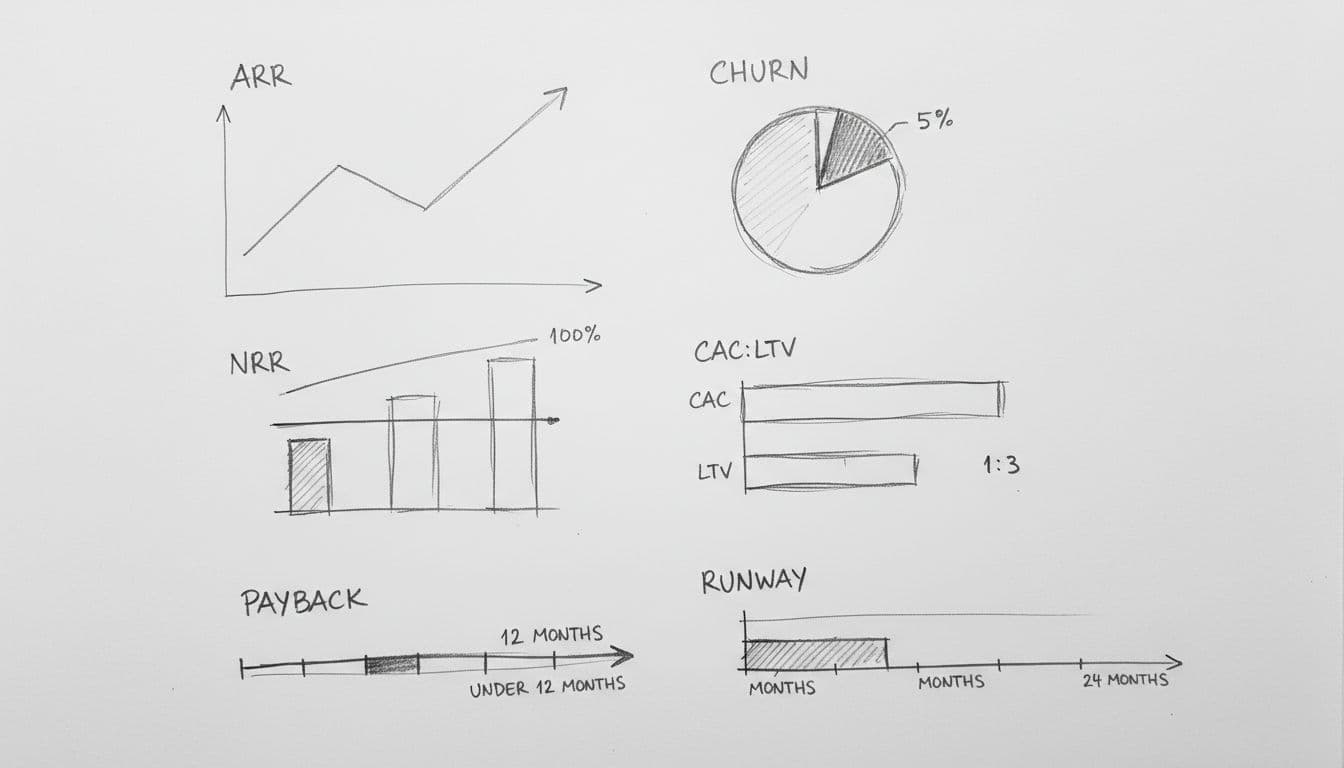
ARR and MRR, the growth story in numbers
Recurring revenue is the base of the SaaS story. Investors want to see size and direction. How much revenue is recurring today, how fast is it moving, and is that growth becoming more predictable?
Monthly and quarterly views both help. MRR shows operating rhythm. ARR gives the bigger picture. Together, they show whether growth is compounding or stalling.
Churn and NRR, the signs of whether customers stay and expand
This is where a lot of weak packs fall apart. If customers are leaving faster than new ones arrive, growth isn’t solid. If customers stay but don’t expand, the upside may be limited.
Show logo churn and revenue churn separately. They answer different questions. Then show net revenue retention. Many investors now see NRR above 100% as the minimum sign of a healthy SaaS base, with materially stronger businesses pushing well beyond that. The message is simple: customers should stay, and over time many should spend more.
CAC, LTV, payback, and burn, the proof that growth is efficient
Growth at any cost isn’t a convincing story now. Investors want to know what it costs to acquire a customer, how much value that customer generates, how long it takes to recover acquisition spend, and how much cash is being burned while you grow.
LTV:CAC still matters because it tests the model. A ratio around 3:1 is generally healthy. Payback matters because it shows how quickly growth turns back into usable cash. Burn matters because it tells investors how much pressure sits underneath the plan.
These numbers need clean definitions. If sales and marketing costs are treated differently every quarter, confidence drops fast.
Runway and burn multiple, the cash reality check
Runway is not a footnote. It’s the basic survival number. Investors want months of cash left, forecast assumptions, and the sensitivity if growth softens or collections slip.
Burn multiple adds another layer. It shows how much cash the business is using to generate new ARR. If burn is rising without a proportionate return in recurring revenue, every other growth metric becomes less persuasive.
How to make the pack feel credible and easy to use
Presentation matters, but not in the glossy sense. A credible SaaS board pack feels stable, clear, and disciplined. Narrative and numbers should support each other. If the commentary says one thing and the data suggests another, investors will trust the data.
Use the same format every quarter
Changing layout, metric definitions, or section order makes comparison harder. It also raises a question no founder wants in the room: “Why has this moved, and is it because the business changed or because the reporting changed?”
Stable reporting builds trust. Use the same headings, the same formulas, the same labels, and the same colour logic each quarter.
Show trends, not just snapshots
Investors don’t think in single points. They think in movement. Are conversion rates improving? Is churn flattening? Is burn coming under control? A board pack should make that easy to see.
Charts help. So do period-on-period comparisons and actual versus plan views. A snapshot tells you where you are. A trend tells you whether management is in control.
Make every number lead to a decision or action
A good pack doesn’t stop at reporting. It should help the board decide what to do next.
If pipeline coverage is light, the action may be slowing hiring or increasing founder-led sales activity. If NRR is slipping, customer success may need investment. If runway is tightening, the board may need to approve cost action early. The pack should point clearly to those choices.
The mistakes that make investors lose confidence
Weak board packs usually fail in predictable ways. The problem isn’t lack of effort. It’s lack of judgement about what matters.
Too much detail and not enough insight
Long packs full of noise make the real story harder to find. Investors should be able to read the pack in under 30 minutes and know what needs discussion.
More pages don’t mean more control. Most of the time, they mean poor filtering.
Weak commentary that hides the real issue
Numbers without explanation are incomplete. Commentary without substance is worse.
If a metric misses plan, explain the reason, the impact, and the response. Avoid soft language. “Some pressure in sales execution” says very little. “Enterprise deals slipped by six weeks, reducing in-quarter ARR by £120k” is useful.
Missing risks, weak asks, or unclear priorities
Investors want to know what could go wrong, where management needs support, and what matters most right now. A pack with no risks and no asks often feels passive.
Strong founders don’t wait for the board to guess the pressure points. They surface them early, frame the decision, and show control.
Conclusion
Investors want a SaaS board pack that proves the business is getting better, not merely getting bigger. They want evidence of disciplined growth, reliable retention, and sensible cash use.
The packs that work best are short, consistent, and direct. Clear metrics, honest commentary, and a focused list of actions do more for confidence than polished design ever will.
If your pack is easy to trust, the board meeting gets better. So do the conversations that follow.

Over 12 years across Big Four audit, investment banking and corporate advisory. Kishen works with UK SaaS and AI companies on financial strategy, fundraising and board-level CFO support. ICAEW regulated. Big Four trained. Based in London.